gradātim…
The double- or triple-booked last weeks of the school year require the preparation of evaluations, both of students and myself, and a look back on all that has passed since September. Reading passages from Virgil’s Georgics with the high school students during harvest time was definitely a highlight for all of us. We actually live in a place where my students know what it means to have hands and limbs stained purple from the freshly pressed wine grapes. One scholar has called the Georgics Virgil’s love letter to the land, just in the disguise of Greek didactic poetry. While reading Virgil together meant detouring from the textbook for a time, it was worth it. We stopped and looked around us.

photo taken from https://www.sthelena.com/5-harvest-secrets-in-st-helena/
et varios ponit fetus autumnus et alte
mitis in apricis coquitur vindemia saxis.
And autumn, abundant, yields its variety
And high up the grapes ripen on the sunny slopes.
- Georgics II. 521-522 (translation mine)
While Virgil provided the sublime, ascending to it required a renewed commitment every day, gradātim, step by step, gradually, to teach Latin using as many evidence-based second language acquisition (SLA) principles as possible. Pedagogy!! It’s become a key interest of mine, coming as I do from a Montessori background (someday I hope to create a post where I mash together Latin instruction, Montessori educational philosophy, and SLA acquisition theories, and make something out of it). I suppose it’s worth discussing how I became so interested in language instruction and acquisition, because my journey as a language teacher has been just what I titled this post : GRADĀTIM.
When I first studied Latin, there was really only one way to do it: charts. Lots of charts, memorized, and then some curated sentences that made use of the forms from the charts. Since Latin is a highly inflected language, then the endings are important. And so the charts are a primary feature in each chapter of an older textbook. Here’s one for nouns and adjectives:
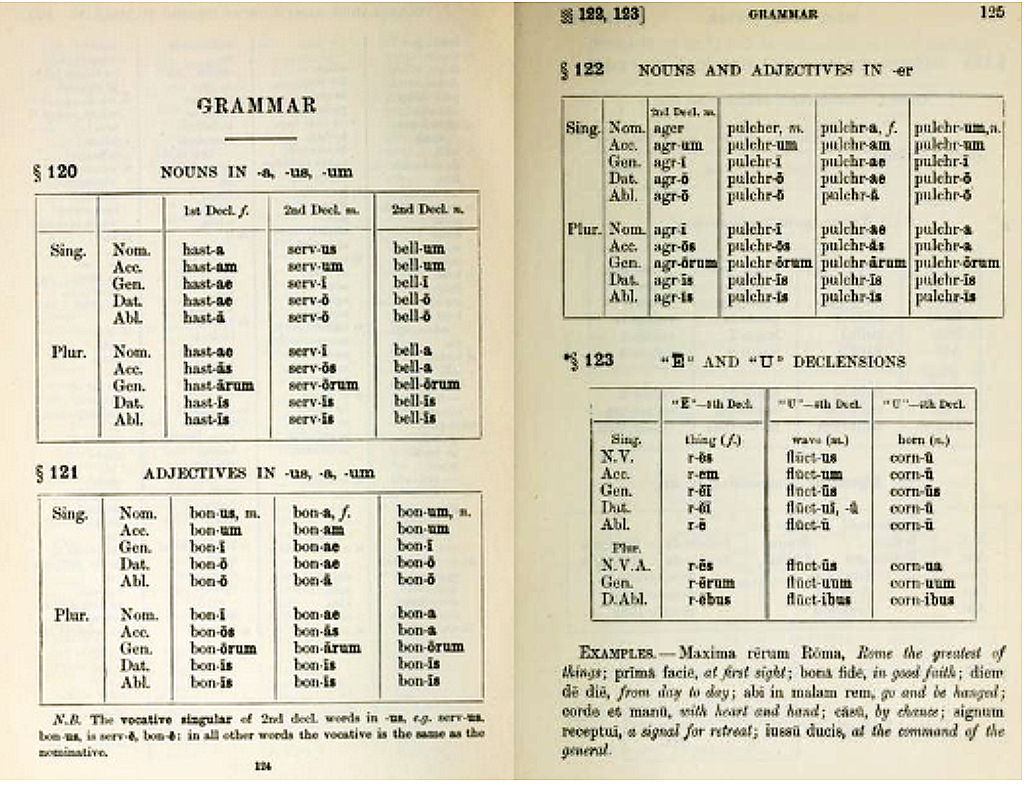
Now, I liked the charts. There were all the possibilities for every noun and adjective, verbs too! Laid out for me. Not that Latin, or ancient Greek, was easy for me- those languages were where I learned to study like I never studied before. But Latin was a code, and I could break it.
Fast forward after years of studying and then teaching Latin and ancient Greek. I was stuck in a rut in my teaching and my students, all of whom had to take Latin, were not all enthusiastic. I mean, there are always a few who seem less interested than others, but the students who were really into Latin looked suspiciously, in their temperaments as students, like….. me.
I was sitting in a tire shop, bored, waiting to get new tires on the car. I turned to my phone and somehow (maybe the rubber fumes from the tires?) discovered Comprehensible Input (CI) and active Latin through an article that popped up from some Facebook group. It was the first of many providential reads that would change how I taught Latin, and it began like this:
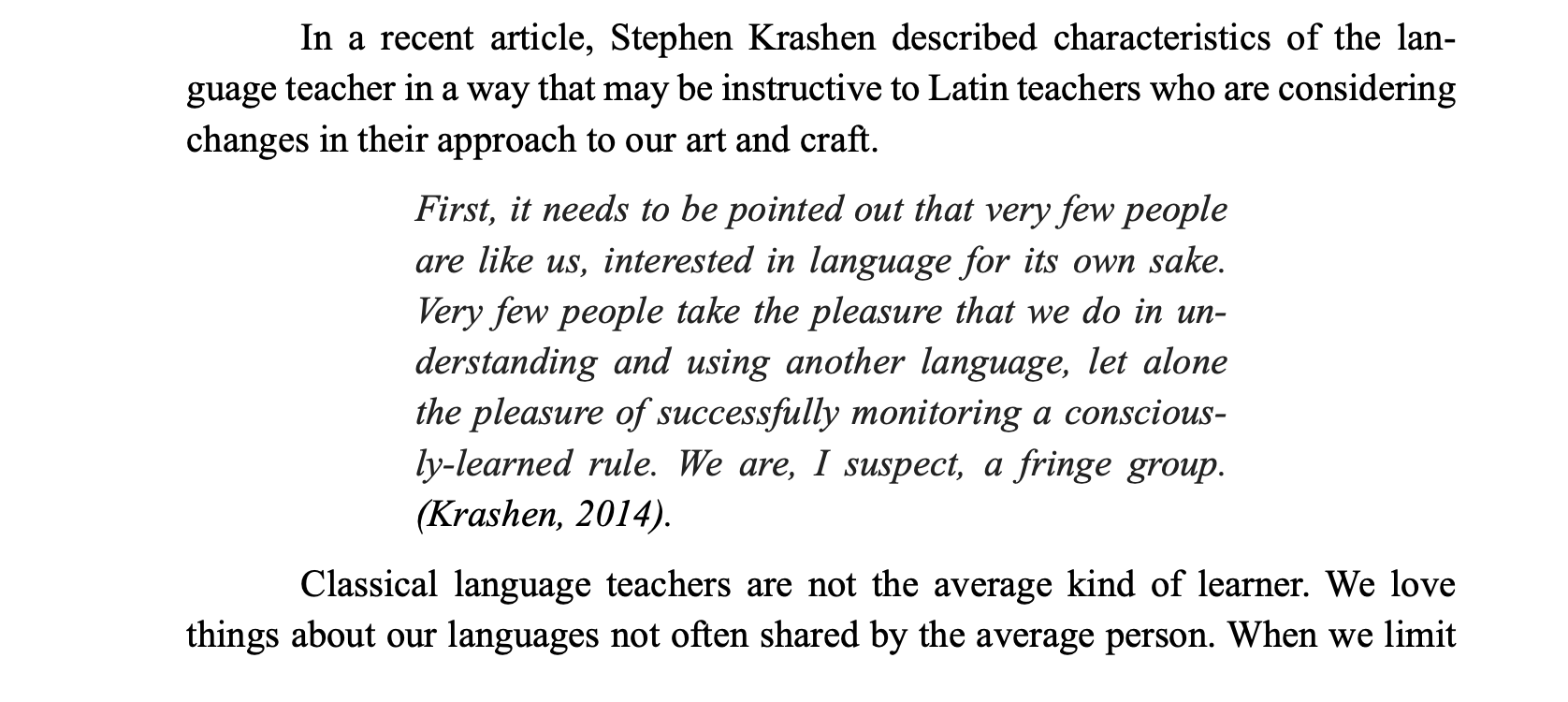
Taken from Robert Patrick’s “Making Sense of Comprehensible Input in the Latin Classroom.” Teaching
Classical Languages 6.1 (Spring 2015): 108-136. ISSN 2160-2220.
What did he say….? A “fringe group”? And we loved things that were “not often shared by the average person”? It stung a bit. I mean, I loved Latin and Greek. Maybe, for some people, these languages came along at a time in their lives when the social landscape was ever changing around them. Maybe, in those awkward years, Latin was a refuge of clarity in a sea of social cues gone awry. I already knew I wasn’t normal (ha! normal). But… could that actually be affecting how I taught the things I loved? (silence)
Well, when you teach, you teach all of the students, so I had to admit that most of my students truly did not enjoy memorizing and applying endings. The textbook approach alone was not really interesting to them. And if I wanted to teach for the long term, then I wanted it to be engaging for the long term, for them and for me. And if I wanted them to have a chance at loving Latin even a teeny weeny little tiny bit, then I needed to change the way that I taught.
My first stop was Latin novellas, a booming field of texts, irregular in quality at times, but really helpful as a first step away from the textbook. Through links and blogs I found the novellas by Andrew Olimpi . These witty and simple Latin novellas remain a constant presence in my classroom even now, six years later.
And this school year, one of my 8th grade classes chose my favorite Olimpi novella to end the school year, Ego, Polyphemus. It’s fitting, with the new Odyssey movie coming out this summer, that we conclude with Odysseus. Ah, but not Odysseus as Homer sees him, but as Polyphemus sees him, with that particular unity of vision native to cyclopes.
And we get see the softer side of Polyphemus- would-be lover, poet…. and of course, rage-eater of hominēs Graecōs when he has a bad day.
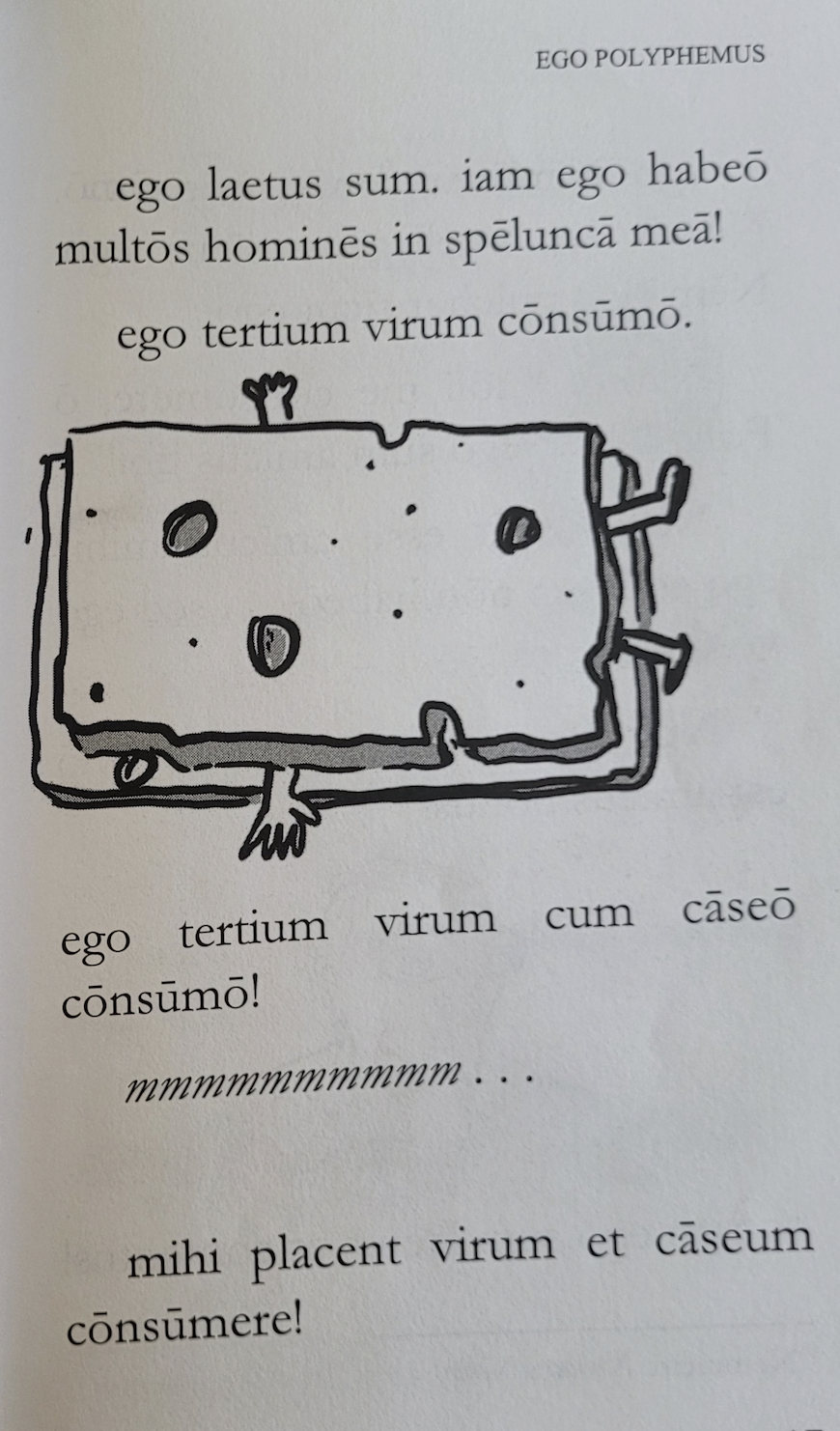
The first time I read this book with students, something happened that had never taken place before: students understood most of what they were reading, they understood the humor in Latin, and they kept reading because they wanted to see what happened next. This book laid the groundwork for some self- reflecting principles that I have continued to research, learn at conferences, and find on webinars and zoom calls when I can:
1) What else can I have the students do to show comprehension, besides translate from Latin into English?
2) How many different ways can I review the same words while maintaining a high level of engagement (ie review without the students realizing it’s review)?
3) How can the lesson be so engaging, that students forget that they are speaking (or reading, or writing) in Latin?
From Virgil to Polyphemus, it has been a good year. And yes, I’m ready for summer!